Branches and Levels of Government
Overview
In the last unit, we looked at many of our rights as listed in the amendments to the Constitution. In this session, you will learn, understand, and demonstrate your understanding of the organizations and functions of the three branches of government.
Through accessing various websites and multimedia applications, you will analyze the formulation, roles, and requirements of the three branches of the United States Government and the separate and concurrent powers of the national and state governments.
Introduction

In this session, you will...
- Take notes on a Powerpoint about the 3 Branches of our government
- Demonstrate a better understanding about the 3 branches via a worksheet
- Understand the Separate and Concurrent powers that exist within our State and National governments by completing a Venn diagram
Introduction to the Three Branches

After the American Revolution the struggle to build a new nation had just begun. After years of living under British rule, most Americans did not trust a strong central government. They wanted the majority of the power in the hands of the people in the individual 13 states. The states were granted this power under the Articles of Confederation which was adopted in 1781. However, problems would quickly occur. These independent people thought of themselves as citizens of their state and not as citizens of a country.
The founders and framers of our government started to believe a stronger central government was needed. In 1787 the Constitutional Convention was held in Philadelphia to create a new plan of government. With much debate and compromise, the delegates agreed to set up a federal system of government with three separate branches. This system of government is outlined in the Constitution of the United States. The framers of the U.S. Constitution wanted to form a union that clearly assigned power to three branches but at the same time guaranteed that the power held by any one branch could be checked by another. The ideas set up in the U.S. Constitution have survived for over 200 years.
In this Unit we'll take a deeper look into the three branches of government.
Three Branches of Government Notes
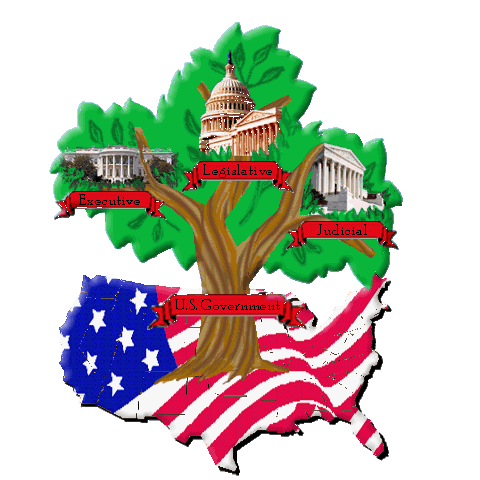
As you read through the Three Branches of Government Powerpoint, think about how the separation of powers allow for a balance of power within the government. Take notes using this template.
My suggestion? Print the blank document and WRITE your notes by hand. (Studies have shown that a students' understanding of the readings increase significantly when doing it this way).
My inbox is located in room 317.
Before viewing, you may want to watch this tutorial on completing a notetaking assignment.
Click on "Cornell Notes" for an example of how to take them.Cornell Notes Grading Rubric :
-
Does not the standard = At least one section appears incomplete
Three Branches of Government Worksheet and Document Annotation

Read:
Use the following websites to complete the Three Branches of Government Worksheet.
Research - Click on the links below:
Respond:
1. Fill out the Three Branches of Our Government worksheet using the websites provided.
2. Annotate or mark your Constitution handout where it refers to these three branches by marking the appropriate sections with a "Leg", "Jud" or "Exec". Submit it along with the worksheet for grading.
Three Branches Venn Diagram
Research:
Take a look at Ben's Guide
Respond:
As you go through Ben's Guide complete the Separate and Concurrent Powers with National and State Governments Venn Diagram.
The Venn Diagram will show your knowledge of shared powers of state and national governments.
Be
sure to completely fill out the entire Venn Diagram. There are several
separate and concurrent powers, so be sure to find them all to get full
credit.
Submit your work via your Brady Gmail account.
Did I Submit It?

Now that you have a better understanding about the different branches and levels of power in our government, let's make sure that you completed all the assignments in this session before moving on to the next one.
√ I submitted it!
- U2S3 -Three Branches of Government Notes
- U2S3 -Three Branches of Our Government worksheet
- U2S3 -Separate and Concurrent Powers with National and State Governments Venn diagram
Are you done? Let's move on to the next session!
