Foundations of Our Government
Overview
In the last unit, we looked at defining the idea of government and its purpose in our lives as citizens.
In this session, you will demonstrate the influences and foundations of democracy through primary source analysis and thinking about the important contributions of enlightenment thinkers on those sources.
Introduction

In this session, you will...
- Take Cornell Notes on a Powerpoint slideshow that looks at the foundations of our government
- Complete an activity on prominent Enlightenment thinkers by referencing the U.S. Constitution
- Complete a worksheet that focuses on defining our values and principles
- Look at the Civil Rights era that helped shape our values and principles
Vocabulary

These are words you need to know that are relevant to the content of this session. Think about what they mean as you go through this session.
Words to know:
- Natural Rights
- Consent
- Social Contract
You should be able to clearly define them by the time you complete this session.
If necessary, search the web dictionary to find the definitions.
Foundations of American Government Notes
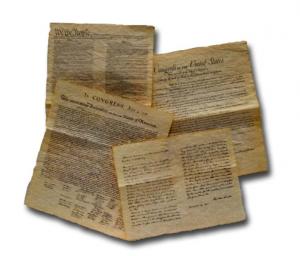
Carefully read the Foundations of American Government Powerpoint and think about the documents that contributed to the making of our government. Take notes using this template.
My suggestion? Print the blank document and WRITE your notes by hand (Studies have shown that a students' understanding of the readings increase significantly when doing so). If you choose to do this, I will have an inbox in room 317 where you can submit your work.
Before viewing, you may want to watch this tutorial on completing a notetaking assignment.
Click on "Cornell Notes" for an example of how to take them.
Cornell Notes Grading Rubric :
-
Does not the standard = At least one section appears incomplete
-
Meets the standard= Sections appear complete
-
Mastered the standard = All sections appear complete and thorough
Influence of John Locke

Most people in the American colonies believed that everyone had a right to life, liberty, and property. These rights are called natural rights.
The idea of natural rights means that all persons have these rights just because they are human beings. Everyone is born with these rights and they should not be taken away without a person's agreement. The idea of these natural rights were brought upon by philosophers hundreds of years ago.
Let's read about a few to gain a better understanding.
Read:
Examine the influence of 17th-century English political philosopher John Locke on the foundations of American democracy. Review primary-source documents by Locke, Jefferson, and Madison.
Research:
Use the following links to find the information you need:
- A Biography of John Locke
- John Locke's Second Treatise of Civil Government (1690) -Read the first two paragraphs. Note: "lord and master of them all" refers to God.
- Thomas Jefferson - Read the first three paragraphs.
- The Declaration of Independence (1776) - Read the paragraph on the drafting of the declaration; at the bottom of the paragraph, click on "read a transcription." Review the first two paragraphs of the document.
- James Madison Biography - Read the first six paragraphs.
- Constitution of the United States (1789) - Read the Preamble, the opening paragraph of the United States Constitution (Refer to your copy of the U.S. Constitution).
Respond:
The steps to follow: Use the suggested web sites to complete "The Influence of John Locke" handout.
Submit your work via your Brady Gmail account.
Defining American Values and Principles
Read:
American values and principles can be summarized by a small number of words. If you were to define these words in your own life what would they look like?
You will need to go to The Interactive Constitution.
Respond:
Answer the Defining American Values and Principles worksheet questions.
Submit your work via your Brady Gmail account.
Civil Rights
Read:
Our American values and principles cannot be limited to one period of time in our history. Our government has made considerable efforts both historically and contemporarily to meet our founding principles and values.
In this activity, you will read about one issue in our nation's history when these founding principles were the guide in some important decision making.
Respond:
Go through the following assignment and answer the questions listed:
Resources:
http://www.cnn.com/2006/EDUCATION/01/31/extra.civil.rights.timeline/index.html
http://www.civilrightsmuseum.org/
Submit your work via your Brady Gmail account.
Did I Submit It?

Now that you have a better understanding about the foundation of our government, let's make sure that you completed all the assignments in this session before moving on to the next one.
√ I submitted it!
- U1S2 - Foundations of American Government Notes
- U1S2 - Influence of John Locke
- U1S2 - Defining American Values and Principles worksheet
- U1S2 - Civil Rights Directions and Activity
Let's move on to the next session!
